



Outdoor workers keep the UK going, playing a vital role across industries including construction, events, agriculture, emergency services, utilities and transport. However, our latest report suggests that many outdoor workers are experiencing high and rising levels of workplace stress, driven largely by workload pressures, long hours and staff shortages.
Our survey of UK indoor and outdoor workers, released during April Stress Awareness Month 2026, explores stress levels among outdoor workers in more detail. The report reveals the biggest causes of stress, the impact on workers’ wellbeing, and attitudes towards mental health support across the outdoor industries.
We’ve also spoken to Lucas Whitehead, Head of Partnerships at Andy’s Man Club, an organisation which provides a safe space for men to open up about the issues they face, providing resources for those in need of stress and mental health support. Outdoor jobs like construction and farming are predominantly made up of male workers and men are more likely than women to die by suicide, making raising awareness, removing stigma and providing support in these spaces vital.

Read on to discover key statistics on outdoor worker stress as well as Luke’s recommended resources for those in need of mental health support.
Stress levels among outdoor workers are rising
The research found that stress levels among outdoor workers are high, with nearly three-quarters reporting moderate to very high stress levels at work. Overall, 72% of people who work either all or part of the time outdoors, said that they are more than just slightly stressed at work.
When compared to indoor workers, data shows that outdoor workers are actually more likely to report high stress levels, suggesting that these industries may face particular pressures related to workload and working conditions.
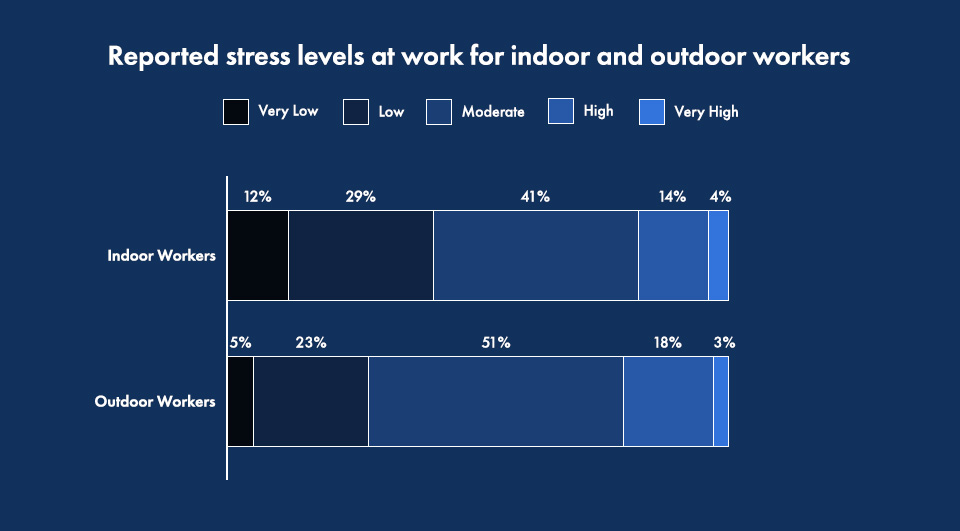
Outdoor workers show a higher concentration of moderate-to-high stress levels compared to indoor workers.
The data also found that workplace stress is not improving. The vast majority of outdoor workers (69%) said their stress levels are either the same or higher than they were 12 months ago. Indicating that stress is becoming a growing issue across outdoor industries, rather than improving over time.
Biggest causes of stress for outdoor workers
Contrary to what many might expect, the biggest causes of stress for outdoor workers are not extreme weather or safety risks, but workload and business pressures.
The ten most commonly cited causes of stress were:
- Tight deadlines (26%)
- Long hours (23%)
- Staff shortages (22%)
- Dealing with clients and customers (20%)
- High workloads (19%)
- Physical demands (19%)
- Pressure from management (17%)
- Financial pressures such as, irregular incomes or low pay (15%)
- Higher cost of living (14%)
- Working in extreme weather (13%)
Factors such as working in extreme weather, health and safety risks, and job insecurity were mentioned less frequently, suggesting that operational and business pressures are the main drivers of stress. This points to resourcing, staffing levels and workload management as key areas where employers could help reduce stress among their teams.
Mental health stigma and workplace culture
The survey also indicated that workplace culture may be preventing some outdoor workers from speaking openly about stress and mental health.
Over half of outdoor workers said there is pressure in their industry to push through stress rather than talk about it, and many said they avoid seeking help because they feel they should handle stress themselves.
A significant proportion believe there is still a stigma around mental health in their industry and that they do not feel comfortable talking to managers or colleagues about stress. Many workers also feel that mental health is not taken as seriously as physical health, highlighting a potential gap in workplace wellbeing support.
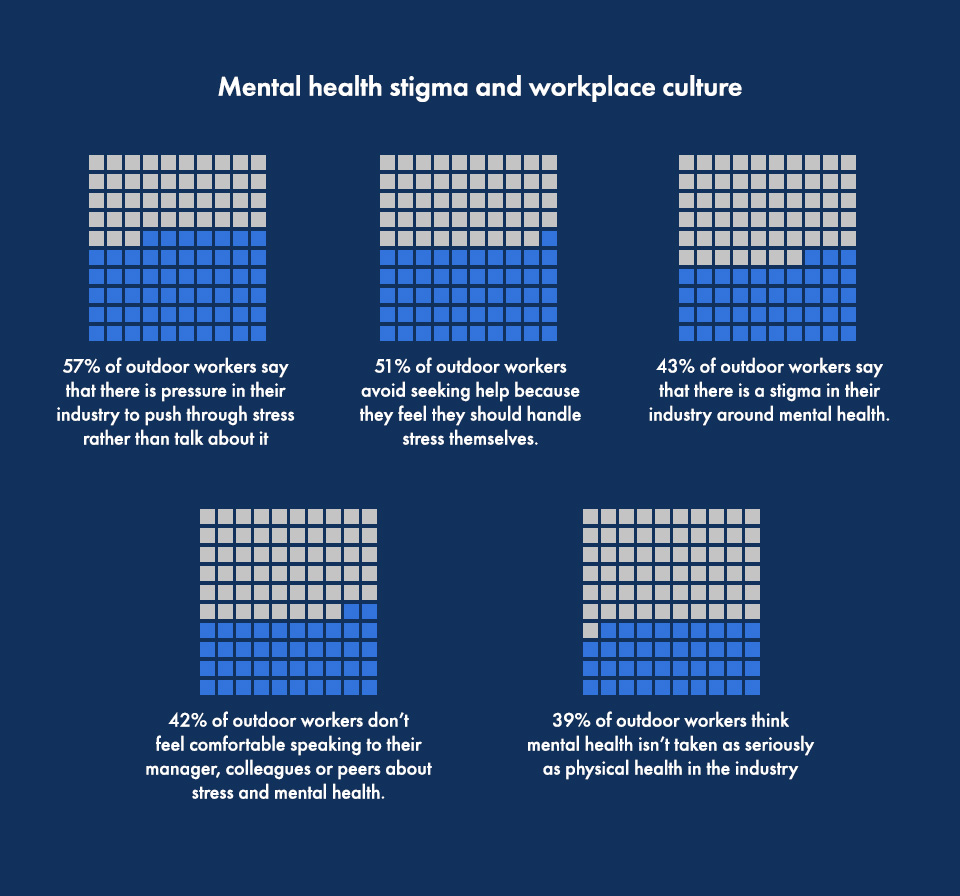
Cultural barriers remain high in outdoor industries, with over half of workers feeling pressured to “push through” stress rather than discussing it.
The impact of stress on wellbeing
Workplace stress is having a clear impact on workers’ health and wellbeing. The most commonly reported effects of stress among outdoor workers include anxiety, physical exhaustion and trouble sleeping. Some workers also reported strained relationships, reduced productivity, taking time off work and depression.
These findings show that workplace stress is not only affecting wellbeing but may also be affecting productivity, absence and performance.
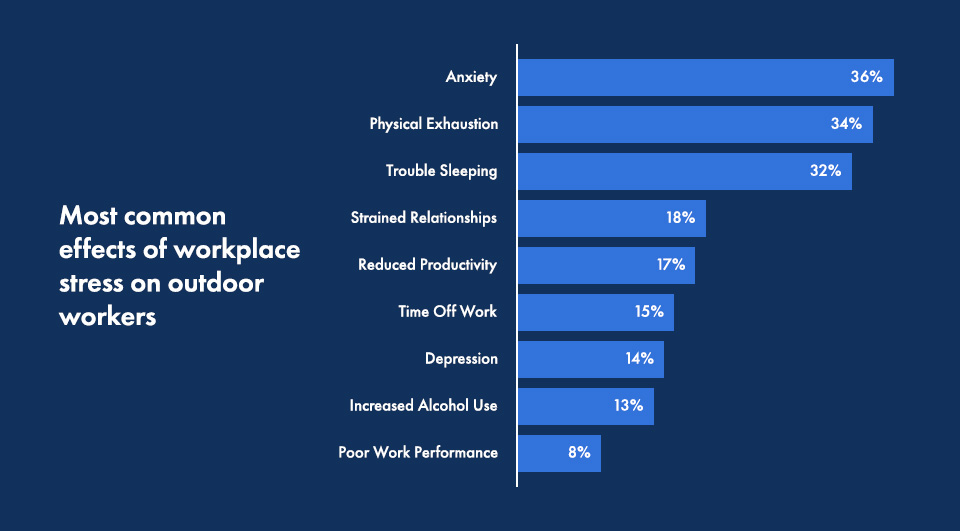
Workplace stress primarily manifests as anxiety and physical exhaustion, impacting both the mental well-being and physical recovery of outdoor workers.
How outdoor workers are coping with stress
When it comes to coping mechanisms, many outdoor workers rely on exercise, hobbies, and talking to friends and family to manage stress. Some also speak to colleagues or seek professional support such as counselling.
However, others reported coping mechanisms such as alcohol use, gambling or ignoring stress and pushing through it.
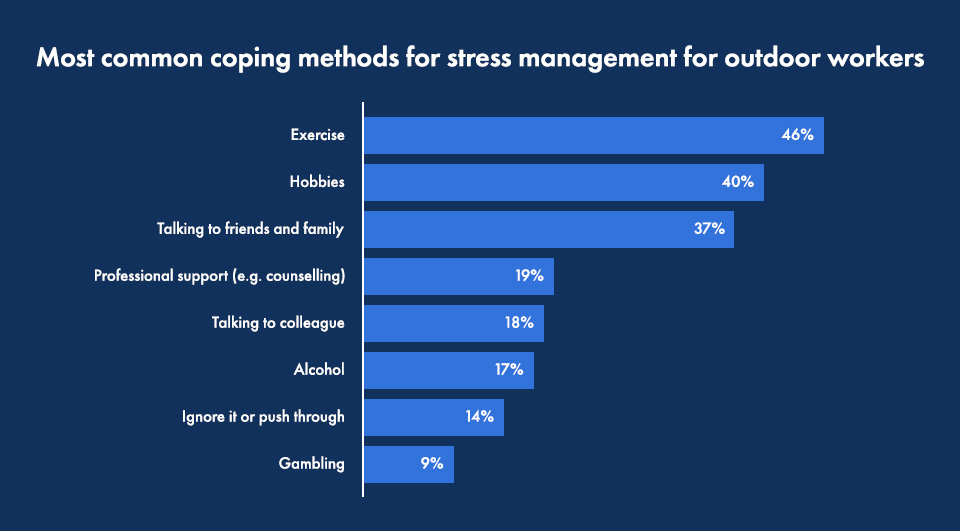
Positive coping mechanisms like exercise and hobbies are widely used, but there is a notable gap between seeking support from friends (37%) versus seeking professional help (19%).
Luke shares four resources for those experiencing stress at work:
1. ANDYSMANCLUB
We run peer-to-peer support groups for men over 18 going through storms in their lives, every Monday at 7 pm, excluding bank holidays. Clubs are free to attend with no registration required. To find out more, email info@andysmanclub.co.uk or head to andysmanclub.co.uk
ANDYSMANCLUB is a peer-led charity, so we are not professional mental health support workers. If you need different support, please contact one of these excellent groups.
2. SAMARITANS
If you need to talk to someone urgently, you can call the Samaritans free any time, from any phone, on 116 123.
3. CALM
CALM (Campaign Against Living Miserably) run a free and confidential helpline and livechat – 7 hours a day, 7 days a week for anyone who needs to talk.
4. CALL 111
You can now call 111 free of charge and select option 2 to be connected to a mental health professional.
If someone’s life is at immediate risk, please contact 999.
Workplace mental health support
Employer-provided mental health support is not being widely used by outdoor workers. Almost a third of outdoor workers said they do not have employer-provided mental health support, while others said they were unsure if support was available or chose not to use it. Overall, only around a quarter of workers said they had used workplace mental health support. This suggests there may be an opportunity for employers to improve awareness, access and uptake of mental health support services.
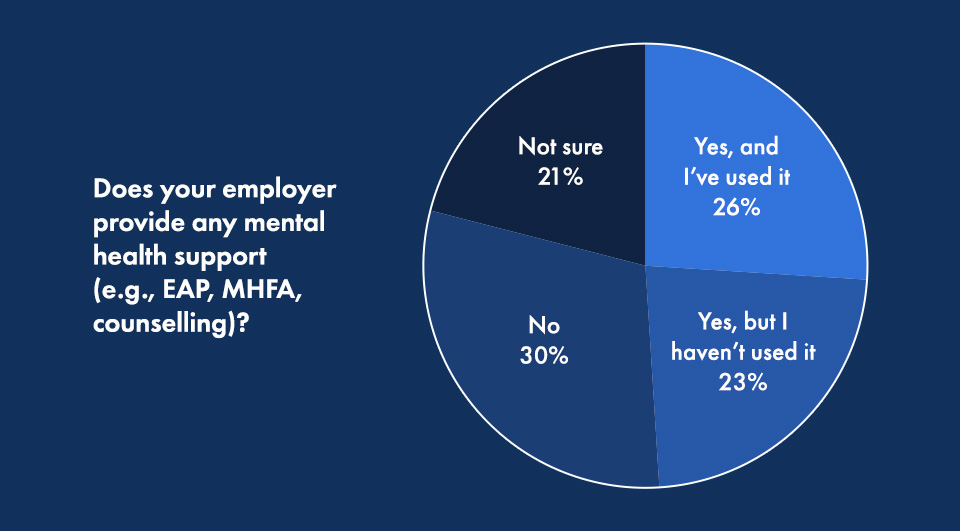
Access to support is split; while nearly half of workers have access to employer-provided mental health resources, 51% either don’t have support or are unaware of its existence.
The most stressful outdoor jobs
According to respondents, the outdoor roles perceived to be the most stressful include emergency services workers such as police, firefighters and paramedics, followed by farmers and agricultural workers, traffic management and parking enforcement officers, construction workers, and highways maintenance workers.
These roles are often associated with long hours, high responsibility, staff shortages and public interaction, which may contribute to higher stress levels.
Breaking down barriers and opening up conversation #itsokaytotalk
Overall, this survey research found that stress is a significant and growing issue across outdoor industries, driven primarily by workload pressures such as deadlines, long hours and staff shortages. While outdoor environments and physical demands play a role, operational pressures appear to be the main cause of stress for many workers.
The findings also highlight ongoing mental health stigma in some industries and low use of workplace mental health support, suggesting that more could be done to support worker wellbeing and encourage open conversations about stress and mental health. That’s why we’ve created a range of heras fencing covers and barrier covers in collaboration with Andy’s Man Club, to help raise awareness and break down barriers when it comes to stress in the workplace and open up conversations among outdoor workers regarding mental health.
Read about the collaboration and view the exclusive Andy’s Man Club #itsokaytotalk range of barrier and fencing covers.
Methodology: This survey research was conducted by The Leadership Factor on behalf of Monster-Mesh, during March 2026. 500 UK workers (300 indoor and 200 outdoor or partly outdoor workers) were surveyed asking about their experience of stress at work.